
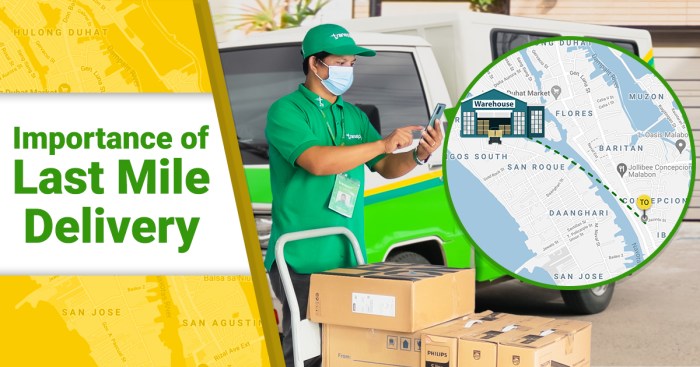
Last-mile delivery, the final leg of the supply chain journey, presents unique challenges and opportunities. This crucial stage, encompassing the movement of goods from a distribution center to the end consumer, significantly impacts customer satisfaction, operational efficiency, and overall profitability. Factors such as distance, traffic congestion, delivery windows, and the increasing demand for speed and convenience all contribute to its complexity.
This exploration delves into the intricacies of last-mile delivery, examining its cost optimization, technological advancements, sustainability concerns, and the profound impact of e-commerce.
We will analyze various delivery methods, from traditional trucking to drone delivery and explore the role of technology in optimizing routes, predicting delivery times, and improving overall efficiency. The discussion will also address the environmental implications of last-mile delivery and explore sustainable solutions to mitigate its carbon footprint. Finally, we’ll examine future trends and innovations that are shaping the future of this critical aspect of modern supply chains.
Defining Last-Mile Delivery
Last-mile delivery represents the final stage in the supply chain, encompassing the movement of goods from a transportation hub to the end customer’s location. It’s a critical yet often overlooked component, directly impacting customer satisfaction and overall supply chain efficiency. Understanding its nuances is essential for businesses aiming for optimized logistics and enhanced customer experience.Last-mile delivery is characterized by its inherent complexities and variability.
Unlike earlier stages involving large-scale transportation, this phase deals with individual deliveries to diverse locations, often with tight time windows and specific handling requirements. The variability in delivery addresses, customer availability, and traffic conditions presents unique challenges that significantly impact cost and efficiency. Furthermore, the last mile is often the most expensive part of the entire delivery process, accounting for a significant portion of overall logistics costs.
Successfully navigating these challenges requires sophisticated planning, flexible execution, and often a combination of delivery methods.
Challenges Unique to Last-Mile Delivery
The last mile presents several unique challenges compared to other supply chain stages. High costs associated with individual deliveries, particularly in densely populated urban areas, are a major concern. Traffic congestion, unpredictable delivery times, and the need for specialized vehicles (e.g., smaller vans for navigating narrow streets) all contribute to increased expenses. Furthermore, managing last-mile logistics requires sophisticated route optimization software and real-time tracking to ensure timely deliveries and efficient resource allocation.
The need to accommodate varying customer preferences (e.g., delivery time windows, specific drop-off locations) adds another layer of complexity. Finally, the increasing demand for faster delivery speeds, driven by customer expectations, puts significant pressure on last-mile operations. Meeting these expectations requires investment in advanced technologies and optimized processes.
Last-Mile Delivery Methods
The choice of last-mile delivery method significantly impacts cost, speed, and suitability for different products and customer needs. The following table illustrates some common options:
| Method | Cost | Speed | Suitability |
|---|---|---|---|
| Direct Delivery (Company Vehicles) | High (fixed costs, driver wages) | Moderate to High (depends on route optimization) | Suitable for high-value, time-sensitive goods; control over delivery process. |
| Third-Party Logistics (3PL) | Moderate (variable costs, depending on contract) | Moderate (dependent on 3PL provider’s efficiency) | Suitable for businesses lacking in-house delivery capabilities; scalability. |
| Crowdsourced Delivery | Moderate to Low (per-delivery fees) | Moderate (depends on availability of drivers) | Suitable for smaller, less time-sensitive packages; cost-effective for high volume. |
| Click and Collect | Low (customer collects) | High (immediate availability at designated location) | Suitable for customers prioritizing convenience and speed; limited geographical reach. |
| Postal Service | Low (standard rates) | Low (longer delivery times) | Suitable for low-value, non-time-sensitive goods; wide geographical coverage. |
Last-Mile Delivery Costs and Optimization
Last-mile delivery represents a significant portion of the overall supply chain cost, often exceeding 50% in some industries. Understanding and optimizing these costs is crucial for maintaining profitability and competitiveness. This section will delve into the major cost components of last-mile delivery and explore effective strategies for cost reduction without sacrificing service quality.
Effective last-mile delivery hinges on efficient cost management. Ignoring this aspect can significantly impact a business’s bottom line. Understanding the various cost drivers allows for targeted optimization strategies, ultimately leading to improved profitability and customer satisfaction.
Major Cost Components of Last-Mile Delivery
Several factors contribute to the high cost of last-mile delivery. Identifying these key areas allows for a more strategic approach to cost reduction.
- Transportation Costs: This includes fuel, vehicle maintenance, driver salaries, and insurance. These costs are directly influenced by factors such as distance traveled, traffic congestion, and the type of vehicle used.
- Labor Costs: This encompasses the wages and benefits of delivery drivers, warehouse personnel involved in picking and packing, and customer service representatives handling delivery-related inquiries. Labor costs are affected by factors such as wage rates, overtime, and the efficiency of warehouse operations.
- Technology Costs: Investment in route optimization software, GPS tracking systems, and delivery management platforms are essential for efficient last-mile operations. These technologies can improve efficiency, but also represent a significant upfront and ongoing expense.
- Packaging and Handling Costs: The cost of packaging materials, handling of goods within warehouses and during transit, and potential damage claims all contribute to the overall expense. Efficient packaging and careful handling are crucial for minimizing these costs.
- Failed Delivery Costs: Missed deliveries due to incorrect addresses, customer unavailability, or logistical issues lead to additional costs associated with rescheduling and redelivery attempts. Improved communication and address verification processes can mitigate these costs.
Strategies for Optimizing Last-Mile Delivery Costs
Numerous strategies can be employed to reduce last-mile delivery costs without compromising service levels. A multi-faceted approach is often most effective.
- Route Optimization Software: Utilizing sophisticated software to plan efficient delivery routes, considering factors like traffic patterns and delivery time windows, can significantly reduce fuel consumption and driver labor costs. This can lead to a reduction in both time and distance traveled.
- Delivery Consolidation and Batching: Grouping multiple deliveries to the same geographic area or time window reduces the number of individual trips, thereby decreasing transportation and labor costs. This strategy improves efficiency by optimizing vehicle utilization.
- Improved Warehouse Management: Streamlining warehouse operations, including efficient picking and packing processes, can reduce handling times and improve overall delivery speed. This minimizes labor costs and enhances customer satisfaction.
- Crowdsourced Delivery: Utilizing independent contractors or gig workers for last-mile delivery can be a cost-effective solution, especially for smaller businesses or during peak seasons. However, careful management and quality control are crucial to maintain service levels.
- Strategic Partnerships: Collaborating with other businesses or logistics providers can offer economies of scale and access to more efficient delivery networks. Shared resources and optimized routes can lead to substantial cost savings.
Hypothetical Scenario: Impact of Optimization Strategies
Consider a hypothetical e-commerce business delivering packages across a metropolitan area. Currently, they use a traditional delivery model with individual deliveries and limited route optimization. Their average delivery cost per package is $15. By implementing route optimization software and consolidating deliveries, they reduce the number of trips by 20% and decrease fuel consumption by 15%. Simultaneously, they invest in improved warehouse management, reducing handling time by 10%.
These combined optimizations reduce their average delivery cost to $11 per package, representing a 27% decrease. This also leads to a 15% reduction in delivery times, improving customer satisfaction.
Technology’s Role in Last-Mile Delivery
Technology is rapidly transforming the last-mile delivery landscape, driving efficiency gains and enhancing customer satisfaction. From route optimization software to sophisticated tracking systems, technological advancements are addressing persistent challenges in this crucial stage of the supply chain. The integration of these technologies is no longer a luxury but a necessity for businesses aiming to remain competitive.
The impact of technology spans across various aspects of last-mile delivery, significantly influencing operational efficiency, cost reduction, and the overall customer experience. Data-driven insights, coupled with automation and innovative delivery methods, are reshaping the industry’s dynamics.
Key Technologies Impacting Last-Mile Delivery
Several key technologies are playing a pivotal role in improving last-mile delivery efficiency and customer satisfaction. These advancements are streamlining operations, reducing costs, and providing customers with greater transparency and control over their deliveries.
- Route Optimization Software: These sophisticated systems utilize algorithms and real-time data (traffic, weather, delivery windows) to create the most efficient delivery routes, minimizing travel time and fuel consumption. Examples include platforms like Route4Me and OptimoRoute.
- GPS Tracking and Telematics: Real-time tracking of delivery vehicles allows for monitoring progress, identifying delays, and providing accurate estimated time of arrival (ETA) updates to customers. This increases transparency and reduces customer anxiety.
- Delivery Management Systems (DMS): These systems integrate various aspects of the delivery process, from order management and route planning to driver dispatch and customer communication. They provide a centralized platform for managing and optimizing the entire last-mile operation.
- Mobile Apps and Customer Portals: Customer-facing mobile apps allow for real-time tracking, rescheduling of deliveries, and communication with delivery personnel. This enhances transparency and customer control.
- Autonomous Vehicles and Drones: While still in early stages of widespread adoption, autonomous vehicles and drones offer the potential to revolutionize last-mile delivery by automating the delivery process and potentially reducing costs.
Data Analytics and Route Optimization
Data analytics plays a crucial role in improving route optimization and delivery prediction. By analyzing historical delivery data, traffic patterns, weather forecasts, and other relevant factors, businesses can create more efficient routes, predict potential delays, and optimize resource allocation. For example, analyzing past delivery data can reveal peak delivery times and areas with high traffic congestion, allowing for proactive adjustments to delivery schedules and route planning.
A company using data analytics might find that deliveries in a particular area consistently experience delays during rush hour. This insight allows them to adjust delivery schedules to avoid peak times or reroute deliveries to less congested areas. Predictive modeling, based on historical data and real-time information, can further enhance accuracy in ETA predictions, improving customer satisfaction and reducing delivery times.
Drones versus Traditional Delivery Vehicles
Drones and traditional delivery vehicles represent distinct approaches to last-mile delivery, each with its own advantages and limitations. The choice between them depends on factors such as delivery distance, payload capacity, regulatory environment, and cost considerations.
| Feature | Drones | Traditional Vehicles |
|---|---|---|
| Cost | Potentially lower for short distances, higher initial investment | Higher operating costs, especially fuel |
| Speed | Faster for short distances, bypassing traffic | Variable, affected by traffic |
| Payload Capacity | Limited | Higher |
| Reach | Limited by range and regulations | Greater reach |
| Environmental Impact | Potentially lower carbon footprint (depending on power source) | Higher carbon footprint |
For example, drone delivery is well-suited for delivering small packages to remote areas or making quick deliveries within a limited radius, such as delivering medications to hospitals or delivering urgent documents. Traditional vehicles, on the other hand, remain essential for transporting larger, heavier items over longer distances.
Supply Chain Integration and Last-Mile Delivery
Effective last-mile delivery isn’t an isolated operation; it’s intricately woven into the broader fabric of the supply chain. Seamless integration across all stages – from procurement to final delivery – is crucial for optimizing efficiency, reducing costs, and enhancing customer satisfaction. This requires robust communication, real-time visibility, and a well-orchestrated process.Successful last-mile delivery hinges on the seamless collaboration and efficient communication between various supply chain stages.
Real-time data sharing and coordinated efforts between warehousing, transportation, and delivery personnel ensure timely and accurate deliveries, minimizing disruptions and delays. This integrated approach fosters a responsive and adaptable supply chain capable of handling unexpected challenges and meeting evolving customer demands.
The Importance of Communication and Collaboration
Effective communication and collaboration are the cornerstones of successful last-mile delivery within a broader supply chain context. Open communication channels between suppliers, manufacturers, warehouses, transportation providers, and delivery personnel are essential. This facilitates the smooth flow of information regarding order status, inventory levels, delivery schedules, and potential disruptions. For example, a delay in warehouse processing can be communicated promptly to the transportation provider, allowing them to adjust their schedule and prevent delays in delivery to the end customer.
Regular meetings, shared dashboards, and collaborative platforms can facilitate this communication. The result is improved responsiveness, reduced errors, and enhanced customer satisfaction.
Real-Time Tracking and Visibility Enhance Supply Chain Efficiency
Real-time tracking and visibility tools significantly enhance overall supply chain efficiency by providing complete transparency into the location and status of shipments at every stage. This allows for proactive problem-solving and timely intervention in case of delays or unforeseen circumstances. For instance, if a delivery vehicle experiences a mechanical issue, real-time tracking alerts the dispatch team, enabling them to reroute the shipment or dispatch a replacement vehicle, minimizing delivery delays.
Furthermore, this data can be used to analyze delivery patterns, optimize routes, and improve resource allocation. This level of visibility also empowers businesses to provide accurate delivery estimates to customers, enhancing their experience and building trust.
Last-Mile Delivery Integration with Warehousing and Transportation
A well-integrated last-mile delivery process seamlessly connects warehousing and transportation operations. The following steps illustrate a typical process:
- Order Placement and Processing: The customer places an order, which is processed through the company’s order management system. This system integrates with the warehouse management system (WMS).
- Warehouse Picking and Packing: The WMS directs warehouse personnel to pick and pack the order based on the customer’s specifications. Items are prepared for shipment.
- Transportation Planning and Dispatch: The WMS communicates the order details to the transportation management system (TMS), which optimizes routes and assigns the order to the most appropriate delivery vehicle based on factors such as location, delivery window, and vehicle capacity.
- In-Transit Tracking and Monitoring: The TMS provides real-time tracking of the shipment, allowing for monitoring of its progress and identification of potential delays.
- Last-Mile Delivery and Confirmation: The delivery driver receives the order details and delivers it to the customer. Upon successful delivery, the system updates the order status and notifies the customer.
- Post-Delivery Reporting and Analysis: Data from each stage is collected and analyzed to identify areas for improvement and optimize future deliveries. This includes delivery times, routes, and customer feedback.
Future Trends in Last-Mile Delivery
The last-mile delivery landscape is in constant flux, driven by evolving consumer expectations, technological advancements, and the ever-increasing pressure for efficiency and sustainability. Understanding these emerging trends is crucial for businesses to remain competitive and adapt to the future of logistics. This section explores key trends and their predicted impact.
Several key factors are shaping the future of last-mile delivery, including the rise of automation, the increasing demand for speed and convenience, and a growing focus on sustainability. These trends are not isolated but interconnected, influencing each other and driving innovation across the entire delivery ecosystem.
Emerging Trends and Technologies
Several emerging trends and technologies are poised to significantly reshape last-mile delivery. These innovations aim to improve efficiency, reduce costs, enhance customer experience, and promote sustainability.
- Autonomous Vehicles: Self-driving delivery robots and vehicles are becoming increasingly prevalent, offering the potential for 24/7 delivery and reduced labor costs. Companies like Nuro and Starship Technologies are already deploying autonomous delivery robots in various locations. These robots can navigate sidewalks and designated areas, delivering packages directly to customers’ doorsteps.
- Drone Delivery: Drone technology continues to mature, offering a faster and more efficient way to deliver packages, especially in remote or congested areas. Companies like Amazon and UPS are actively testing and implementing drone delivery programs, focusing on faster delivery times and reduced reliance on traditional ground transportation.
- Micro-fulfillment Centers: These smaller, strategically located warehouses are designed to optimize last-mile delivery by bringing inventory closer to consumers. This reduces transportation times and costs, improving delivery speed and efficiency. Examples include automated micro-fulfillment centers implemented by companies like Ocado and Walmart.
- Hyperlocal Delivery Networks: The rise of crowdsourced delivery platforms and partnerships with local businesses are creating hyperlocal delivery networks. This enables faster and more cost-effective deliveries within specific geographic areas, leveraging existing infrastructure and resources.
- AI and Machine Learning: AI and machine learning are being used to optimize routing, predict delivery times, and improve overall efficiency. These technologies analyze vast amounts of data to identify patterns and optimize delivery processes, leading to significant cost savings and improved customer satisfaction.
Impact on Businesses and Consumers
The trends discussed above will significantly impact both businesses and consumers. These impacts are multifaceted and will reshape the industry’s dynamics.
- Businesses: Businesses will need to adapt to the changing landscape by investing in new technologies, optimizing their logistics networks, and focusing on data-driven decision-making. They will need to embrace automation, optimize inventory management, and improve their supply chain visibility. The shift towards sustainability will also necessitate changes in packaging and transportation methods.
- Consumers: Consumers will benefit from faster, more convenient, and more sustainable delivery options. They can expect increased delivery speed, greater flexibility in delivery times and locations, and more transparency in the delivery process. The rise of autonomous delivery may also lead to lower prices due to reduced labor costs.
A Futuristic Last-Mile Delivery Scenario
Imagine a bustling city in 2035. Small, autonomous delivery robots zip silently along sidewalks, navigating crowds with ease. Drones soar overhead, delivering packages to suburban homes within minutes of an order being placed. Micro-fulfillment centers, strategically located throughout the city, ensure that inventory is always close to consumers. Consumers use a seamless mobile app to track their deliveries in real-time, choosing their preferred delivery method and time slot.
Delivery options are personalized, factoring in individual preferences and real-time traffic conditions. Sustainable packaging and eco-friendly transportation methods are the norm, minimizing the environmental impact of last-mile delivery. The entire process is highly efficient, transparent, and customer-centric, representing a significant improvement over today’s system.
Efficient last-mile delivery is no longer a mere operational detail; it’s a strategic imperative. As e-commerce continues its relentless growth, the pressure to deliver goods swiftly, cost-effectively, and sustainably will only intensify. By embracing technological advancements, optimizing logistics, and prioritizing sustainable practices, businesses can navigate the complexities of last-mile delivery and gain a competitive edge. The future of last-mile delivery lies in a seamless integration of technology, sustainability, and customer-centric strategies, promising a more efficient, environmentally conscious, and ultimately, more satisfying experience for both businesses and consumers.
General Inquiries
What are the biggest challenges in last-mile delivery?
High costs, traffic congestion, unpredictable delivery windows, finding qualified drivers, and managing returns are major hurdles.
How can I reduce last-mile delivery costs?
Optimize routes, consolidate shipments, utilize efficient delivery methods (e.g., crowd-sourced delivery), and negotiate favorable rates with carriers.
What is the role of AI in last-mile delivery?
AI enhances route optimization, predicts delivery times, automates tasks, and improves customer service through chatbots and personalized communication.
What are some sustainable last-mile delivery options?
Electric vehicles, cargo bikes, walking delivery, and optimized routing to reduce fuel consumption and emissions are key sustainable options.


