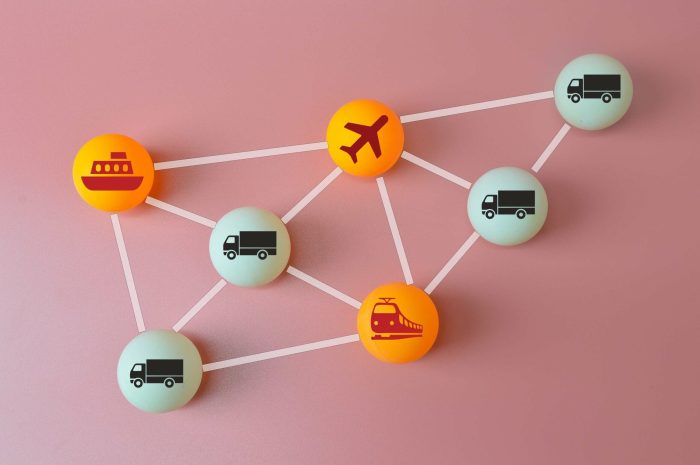
Efficient supply chain logistics are the backbone of modern commerce, seamlessly connecting producers to consumers. This intricate network involves a complex interplay of inventory management, transportation, warehousing, and risk mitigation, all working in concert to deliver goods and services on time and within budget. Understanding the nuances of this system is crucial for businesses aiming to optimize operations, enhance profitability, and maintain a competitive edge in today’s global marketplace.
From the strategic design of supply chain networks to the implementation of cutting-edge technologies like AI and blockchain, this guide delves into the key aspects of supply chain logistics. We will explore various models, examine best practices, and discuss the challenges and opportunities presented by a constantly evolving landscape. We’ll cover everything from optimizing warehouse operations to mitigating the risks of global disruptions, providing a holistic understanding of this critical business function.
Defining Supply Chain Logistics
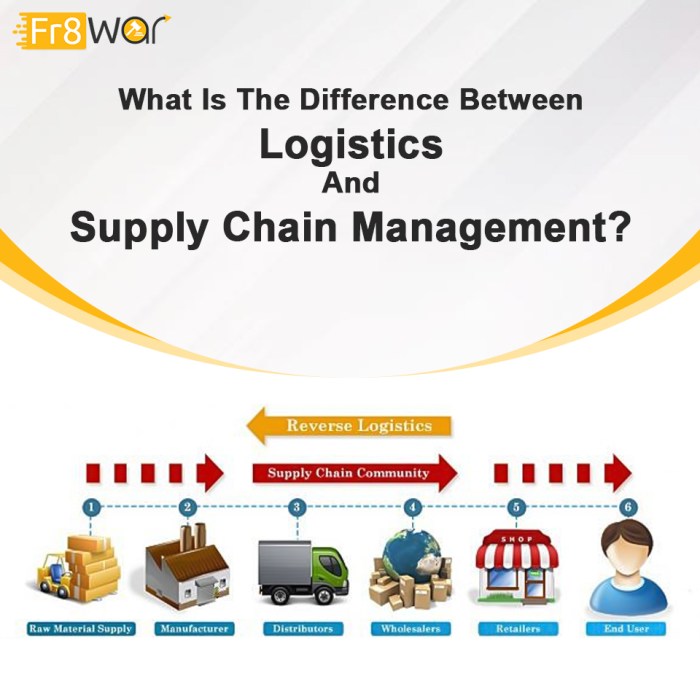
Supply chain logistics is the process of planning, implementing, and controlling the efficient, effective flow and storage of goods, services, and related information from point of origin to point of consumption to meet customer requirements. It’s the engine that drives the movement of products from raw materials to finished goods, encompassing everything from procurement and manufacturing to warehousing, transportation, and delivery.
A well-functioning supply chain logistics system is crucial for businesses to remain competitive and profitable.
Core Components of Supply Chain Logistics
Supply chain logistics comprises several interconnected components working in harmony. These include procurement, which involves sourcing and acquiring raw materials and components; production, encompassing the manufacturing or assembly of goods; warehousing and inventory management, focusing on storage and efficient stock control; transportation, covering the movement of goods between locations; and finally, distribution, which encompasses the final delivery to customers.
Effective integration of these components is essential for optimal efficiency.
Key Differences Between Supply Chain Management and Logistics
While often used interchangeably, supply chain management (SCM) and logistics are distinct but related concepts. Logistics focuses on the efficient movement and storage of goods, representing a subset of SCM. SCM, on the other hand, encompasses a broader perspective, including strategic planning, sourcing, and relationship management across the entire supply chain. In essence, logistics is the operational arm of SCM, responsible for executing the tactical plans developed by SCM.
Examples of Various Supply Chain Logistics Models
Several models exist to optimize supply chain logistics, each with its own strengths and weaknesses. A common model is the lean supply chain, which emphasizes minimizing waste and maximizing efficiency through just-in-time inventory management and streamlined processes. In contrast, agile supply chains prioritize flexibility and responsiveness to changing market demands, often using a combination of forecasting and reactive strategies.
Another example is the resilient supply chain, designed to withstand disruptions and uncertainties, utilizing redundancy and diversification to mitigate risk. Finally, a green supply chain focuses on minimizing environmental impact throughout the entire supply chain, from sourcing sustainable materials to reducing carbon emissions during transportation.
Comparison of Transportation Modes
The choice of transportation mode significantly impacts supply chain efficiency and cost. The table below compares several common modes:
| Transportation Mode | Cost | Speed | Reliability |
|---|---|---|---|
| Road (Trucking) | Moderate | Moderate | Moderate |
| Rail | Low | Slow | High |
| Air | High | Fast | High |
| Sea (Shipping) | Low | Slow | Moderate |
Supply Chain Network Design
Designing an efficient supply chain network is crucial for e-commerce businesses to ensure timely delivery, minimize costs, and maximize customer satisfaction. A well-structured network considers various factors, balancing the need for speed and responsiveness with cost-effectiveness and scalability. This involves strategically locating warehouses and distribution centers, choosing appropriate transportation modes, and optimizing inventory levels across the network.Efficient supply chain network design for a hypothetical e-commerce business, let’s call it “eShop,” selling a range of consumer goods, would involve a multi-stage approach.
Initially, a comprehensive analysis of eShop’s customer base, product portfolio, and order volume would be undertaken to determine the optimal number and location of fulfillment centers. This analysis would also incorporate factors like transportation costs, labor costs, and proximity to key suppliers. Following this, the selection of transportation methods (road, rail, air, or a combination) would be based on speed, cost, and reliability considerations for each leg of the supply chain.
Finally, the network would be continuously monitored and adjusted based on performance data and changing market conditions. For example, during peak seasons like holiday shopping, eShop might utilize temporary warehousing space to manage increased order volume.
Warehouse and Distribution Center Location Factors
Several key factors influence the location of warehouses and distribution centers within a supply chain network. These factors often interact and require careful consideration to achieve an optimal balance. Cost is a significant factor, encompassing land acquisition, construction, and operational expenses. Proximity to major transportation hubs, such as airports and seaports, is vital for efficient inbound and outbound logistics.
Labor availability and cost are also critical, with regions offering a skilled workforce at competitive wages being more attractive. Finally, the location must be suitable for the specific products being handled; for example, temperature-controlled facilities might be needed for perishable goods. Considering these factors, a business like eShop might strategically place a large, central warehouse near a major transportation hub to handle high-volume goods, while smaller, regional distribution centers could be located closer to high-density customer populations for faster delivery.
Centralized versus Decentralized Supply Chain Networks
Centralized and decentralized supply chain networks represent different approaches to managing inventory and distribution. In a centralized network, all inventory is held in a single location, typically a large central warehouse. This simplifies management and reduces inventory costs but can lead to longer delivery times and increased transportation costs, especially for geographically dispersed customers. In contrast, a decentralized network distributes inventory across multiple warehouses or distribution centers located closer to customers.
This improves delivery speed and responsiveness but increases inventory holding costs and the complexity of managing multiple locations. For eShop, a hybrid approach might be most effective, combining a central warehouse for high-volume items with smaller regional distribution centers for faster delivery to densely populated areas. The optimal choice depends on the specific needs and characteristics of the business, its product portfolio, and its customer base.
Optimizing a Supply Chain Network for Cost Reduction
Optimizing a supply chain network for cost reduction involves a systematic approach that encompasses several key steps. First, a thorough analysis of existing costs, identifying areas for potential savings, is crucial. This involves examining transportation, warehousing, inventory holding, and administrative expenses. Next, modeling and simulation techniques can be used to evaluate the impact of different network configurations on overall costs.
This could involve analyzing the cost-effectiveness of different warehouse locations, transportation modes, and inventory management strategies. Once potential improvements are identified, implementation and monitoring are key to ensure the changes deliver the expected cost savings. Continuous monitoring and adjustment are essential to account for changes in demand, market conditions, and technology. For instance, eShop could explore using route optimization software to minimize transportation costs or implement automated warehousing systems to reduce labor costs.
Inventory Management in Supply Chain Logistics
Effective inventory management is crucial for optimizing supply chain efficiency and profitability. It involves balancing the costs of holding inventory against the risks of stockouts and lost sales. Different techniques impact the overall efficiency of the supply chain in various ways, influencing factors like storage costs, order fulfillment times, and customer satisfaction.
Impact of Inventory Management Techniques on Supply Chain Efficiency
Various inventory management techniques exist, each with its own impact on supply chain efficiency. Just-in-Time (JIT) inventory, for example, aims to minimize inventory holding costs by receiving materials only when needed for production. This reduces storage space requirements and minimizes waste from obsolescence, but it relies heavily on precise demand forecasting and reliable supplier relationships. Conversely, a safety stock strategy maintains a buffer of inventory to mitigate the risk of stockouts due to unexpected demand fluctuations or supply chain disruptions.
While this increases holding costs, it ensures higher order fulfillment rates and reduces the risk of lost sales. The optimal technique depends on factors like product demand variability, lead times, storage costs, and the cost of stockouts. A company selling perishable goods might favor JIT to minimize spoilage, while a manufacturer of high-demand electronics might prefer a safety stock approach to avoid lost sales.
Best Practices for Forecasting Demand and Managing Inventory Levels
Accurate demand forecasting is fundamental to effective inventory management. Several methods exist, including moving averages, exponential smoothing, and more sophisticated techniques like machine learning algorithms. These methods analyze historical sales data, seasonal trends, and external factors to predict future demand. Combining quantitative forecasting with qualitative insights, such as market research and expert opinions, can further enhance accuracy.
Managing inventory levels involves setting reorder points and economic order quantities (EOQ). The reorder point determines when to place a new order, considering lead time and demand variability. The EOQ calculates the optimal order quantity to minimize the total cost of inventory, balancing ordering costs and holding costs. Regular inventory audits and cycle counting help maintain accuracy and identify discrepancies.
Challenges of Inventory Management in a Volatile Market
Volatile markets present significant challenges for inventory management. Unpredictable demand fluctuations, supply chain disruptions (such as those caused by geopolitical events or natural disasters), and price volatility make accurate forecasting and inventory control difficult. Geopolitical instability, for instance, can lead to unexpected delays in shipping and increased transportation costs. Sudden changes in consumer preferences can also result in excess inventory of obsolete products.
Effective risk management strategies, such as diversification of suppliers, robust contingency planning, and agile inventory management systems, are crucial for navigating these challenges. Real-time visibility into inventory levels and supply chain processes is also essential for making informed decisions and responding quickly to market changes. For example, a company experiencing a sudden surge in demand due to a viral social media trend needs to be able to rapidly adjust its inventory levels and production to meet the increased demand.
Examples of Inventory Management Software and Their Functionalities
Numerous software solutions support inventory management. Software like SAP Inventory Management, Oracle Inventory Management, and NetSuite Inventory Management provide functionalities such as demand forecasting, inventory tracking, order management, warehouse management, and reporting and analytics. These systems often integrate with other enterprise resource planning (ERP) systems to provide a holistic view of the supply chain. For example, SAP Inventory Management offers advanced analytics tools to identify trends and patterns in demand, enabling proactive inventory adjustments.
Oracle Inventory Management provides real-time visibility into inventory levels across multiple locations, allowing for efficient allocation and replenishment. NetSuite Inventory Management offers features such as automated order fulfillment and barcode scanning for improved accuracy and efficiency. The choice of software depends on the specific needs and size of the business.
Transportation and Warehousing
Effective transportation and warehousing are crucial for a successful supply chain, ensuring goods reach their destination on time and in optimal condition. These two elements are intrinsically linked, with transportation feeding into warehousing and warehousing facilitating efficient outbound transportation. The optimization of both is key to minimizing costs and maximizing customer satisfaction.
Transportation Modes in Supply Chain Logistics
The choice of transportation mode significantly impacts cost, speed, and reliability. Each mode offers unique advantages and disadvantages depending on the specific needs of the supply chain. Road transport, for example, offers flexibility and door-to-door delivery, while sea freight provides cost-effectiveness for large volumes over long distances. Air freight prioritizes speed, ideal for time-sensitive goods, though it is the most expensive option.
Rail transport offers a balance between cost and speed, particularly suitable for bulk commodities over moderate distances.
- Road Transport: High flexibility, door-to-door delivery, suitable for smaller shipments and shorter distances. However, it can be susceptible to traffic congestion and higher fuel costs.
- Sea Freight: Cost-effective for large volumes over long distances, ideal for bulk goods. However, it’s slower than air or road transport and susceptible to delays due to weather conditions.
- Air Freight: Fastest mode of transport, ideal for time-sensitive goods and high-value items. However, it is the most expensive option and has limitations on cargo size and weight.
- Rail Transport: Cost-effective for bulk commodities over moderate distances, offering a balance between speed and cost. However, it lacks the flexibility of road transport and may not reach all destinations directly.
Warehouse Location and Design Considerations
Strategic warehouse location significantly impacts efficiency and cost. Factors to consider include proximity to key markets, transportation infrastructure (access to major highways, rail lines, and ports), labor availability and cost, land cost and availability, and local regulations. Warehouse design should optimize space utilization, considering factors such as product characteristics (size, weight, fragility), storage methods (pallet racking, shelving), order fulfillment processes, and safety regulations.
For example, a company distributing perishable goods would need a warehouse with temperature-controlled storage and close proximity to its customer base.
Warehousing Technologies: Automated Guided Vehicles (AGVs) and Radio-Frequency Identification (RFID)
Modern warehousing increasingly leverages technology to improve efficiency and accuracy. Automated Guided Vehicles (AGVs) are robotic vehicles that move materials around a warehouse autonomously, reducing labor costs and improving efficiency. Radio-Frequency Identification (RFID) tags attached to goods allow for real-time tracking and management of inventory, improving accuracy and reducing stock losses. While AGVs offer significant automation benefits, their implementation requires a substantial initial investment and careful integration into existing warehouse systems.
RFID, while less costly to implement, requires investment in readers and software for data analysis and requires careful consideration of tag placement and durability.
Optimizing Warehouse Operations for Efficiency
Optimizing warehouse operations requires a systematic approach focusing on various aspects. A step-by-step guide is crucial for efficiency.
- Inventory Management: Implement a robust inventory management system to accurately track stock levels, minimizing storage costs and preventing stockouts. This involves regular cycle counting and employing techniques like ABC analysis to prioritize high-value items.
- Layout Optimization: Design a warehouse layout that optimizes workflow, minimizing travel distances and maximizing space utilization. This might involve implementing a zone picking system for faster order fulfillment.
- Technology Integration: Integrate warehouse management systems (WMS) and other technologies (e.g., AGVs, RFID) to automate processes and improve accuracy. Real-time data allows for better decision-making.
- Staff Training: Provide adequate training to warehouse staff on proper procedures, safety regulations, and the use of technology. Well-trained staff are crucial for smooth operations.
- Performance Monitoring: Regularly monitor key performance indicators (KPIs) such as order fulfillment time, inventory turnover rate, and storage costs. This allows for continuous improvement and identification of bottlenecks.
Risk Management in Supply Chain Logistics
Effective risk management is paramount in today’s interconnected global supply chains. Unforeseen disruptions can severely impact profitability, reputation, and even the survival of a business. Proactive identification, assessment, and mitigation of potential risks are crucial for maintaining operational efficiency and ensuring business continuity.
Potential Supply Chain Disruptions and Their Impact
Global supply chains are inherently vulnerable to a multitude of disruptions. These range from natural disasters like earthquakes and hurricanes, which can cause physical damage to infrastructure and halt transportation, to geopolitical instability, including trade wars, political unrest, and pandemics, all capable of disrupting manufacturing, logistics, and consumer demand. Economic downturns can lead to decreased consumer spending and reduced production.
Furthermore, technological failures, such as cybersecurity breaches or system malfunctions, can cripple operations. The impact of these disruptions can be far-reaching, including production delays, inventory shortages, increased costs, damaged reputation, and lost revenue. For example, the 2011 Tohoku earthquake and tsunami in Japan significantly disrupted the global automotive industry due to component shortages.
Strategies for Mitigating Supply Chain Risks
Several strategies can effectively mitigate supply chain risks. Diversification of sourcing and manufacturing locations reduces reliance on single suppliers or regions, thereby lessening the impact of localized disruptions. Robust inventory management, including holding safety stock, ensures sufficient supply even during unexpected events. Strong supplier relationships foster collaboration and information sharing, enabling early detection of potential problems. Investing in advanced technologies, such as blockchain for enhanced traceability and AI for predictive analytics, improves visibility and responsiveness.
Insurance policies can help cover financial losses from unforeseen circumstances. Developing strong risk assessment and monitoring systems, continuously updated with relevant data and intelligence, allows for proactive identification and response to emerging threats. Finally, robust communication channels ensure effective coordination amongst stakeholders during a crisis.
Supply Chain Resilience and Adaptability
Supply chain resilience refers to the ability of a supply chain to withstand and recover quickly from disruptions. Adaptability, on the other hand, is the capacity to adjust to changing circumstances and market demands. Both are crucial for long-term success in a dynamic global environment. A resilient and adaptable supply chain employs flexible strategies, such as agile manufacturing and postponement, to respond to unforeseen events.
It prioritizes continuous improvement, regularly reviewing and updating its risk management plan based on lessons learned and emerging threats. The ability to rapidly reconfigure operations, reroute shipments, and find alternative suppliers is key to minimizing disruption and maintaining competitiveness.
Contingency Plan for a Hypothetical Supply Chain Disruption
Let’s consider a hypothetical scenario: a major earthquake disrupts a key manufacturing facility in a specific region, significantly impacting the production of a crucial component for a major product. The contingency plan would involve:
- Immediate Response: Activate the crisis management team. Assess the extent of the damage and the impact on production. Communicate with customers and stakeholders.
- Short-Term Mitigation: Identify and activate backup suppliers for the affected component. Explore alternative manufacturing locations or expedite existing orders from secondary suppliers. Prioritize orders based on urgency and customer impact.
- Long-Term Recovery: Evaluate the long-term viability of the affected facility. Consider investments in disaster-resistant infrastructure. Diversify sourcing to reduce reliance on a single geographic region. Re-evaluate supplier contracts and relationships.
This plan emphasizes clear communication, swift action, and a focus on both immediate recovery and long-term resilience. Regular drills and simulations are essential to ensure the plan’s effectiveness.
Mastering supply chain logistics is no longer optional; it’s essential for survival and success in today’s competitive business environment. By understanding the core principles, embracing technological advancements, and proactively managing risks, businesses can unlock significant efficiencies, reduce costs, and ultimately enhance customer satisfaction. The journey towards optimizing your supply chain is a continuous process of adaptation and improvement, requiring constant monitoring, analysis, and a commitment to excellence.
This guide provides a strong foundation for that journey.
Expert Answers
What is the difference between supply chain management and logistics?
Supply chain management encompasses the entire process from raw material sourcing to end-customer delivery, while logistics focuses specifically on the efficient movement and storage of goods within that chain.
How can I improve my supply chain’s visibility?
Implement real-time tracking technologies (GPS, RFID), utilize robust inventory management systems, and foster strong communication across all supply chain partners.
What are some common supply chain risks?
Natural disasters, geopolitical instability, supplier disruptions, and unexpected demand fluctuations are all significant risks.
What role does sustainability play in modern supply chains?
Sustainable practices, such as reducing carbon emissions through efficient transportation and responsible sourcing, are increasingly crucial for brand reputation and long-term viability.


