The modern global economy relies heavily on intricate supply chains, yet these systems are increasingly vulnerable to disruptions. From geopolitical instability to unforeseen natural disasters, the ability of businesses to withstand and recover from these shocks—their supply chain resilience—is no longer a competitive advantage, but a critical necessity for survival. This exploration delves into the multifaceted nature of supply chain resilience, examining its key components, influencing factors, and strategies for enhancement.
Understanding supply chain resilience requires a nuanced approach, acknowledging the interplay between internal operational efficiencies and external global forces. We’ll examine how proactive risk management, technological innovation, and collaborative partnerships contribute to building robust and adaptable supply chains capable of navigating the complexities of the 21st-century business environment.
Defining Supply Chain Resilience
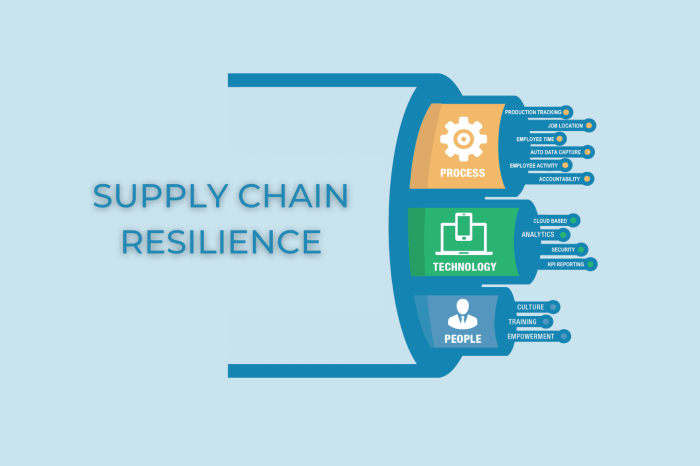
Supply chain resilience refers to a supply chain’s ability to anticipate, withstand, and recover rapidly from disruptions. It’s not simply about avoiding disruptions entirely, but about possessing the flexibility and adaptability to minimize their impact and maintain operations as close to normal as possible. This involves a multifaceted approach encompassing risk management, robust processes, diverse sourcing strategies, and strong relationships throughout the supply chain network.Supply chain resilience goes beyond the concept of robustness.
While a robust supply chain is designed to withstand shocks through redundancy and capacity, resilience implies a dynamic and proactive approach to managing uncertainty. A robust system might withstand a minor earthquake, but a resilient system would also learn from the experience, adapt its design, and potentially even leverage opportunities arising from the disruption. For example, a robust system might have backup generators, while a resilient system would also invest in alternative energy sources and disaster preparedness training for its workforce.
Resilience versus Robustness in Supply Chains
Robustness focuses on building a system that can withstand foreseeable disruptions through redundancy and overcapacity. It emphasizes strength and stability in the face of known risks. Resilience, however, goes further. It encompasses not only the ability to withstand disruptions but also the capacity to adapt, learn, and improve from them. A resilient supply chain anticipates a wider range of potential disruptions, including unforeseen events, and actively seeks to minimize their impact and even capitalize on opportunities.
This requires a more agile and adaptive approach to planning and execution. Consider a manufacturer relying solely on a single supplier. This is robust only if that supplier is highly reliable. A resilient approach would involve multiple suppliers, diversified geographically, to mitigate risk from any single point of failure.
Measuring Supply Chain Resilience
There isn’t a single, universally accepted metric for measuring supply chain resilience. Different approaches focus on various aspects, such as risk exposure, recovery time, adaptability, and financial impact. Some common approaches include quantitative methods, such as simulations and scenario planning, which model the impact of different disruptions on the supply chain. These models can provide insights into vulnerabilities and potential areas for improvement.
Qualitative methods, such as stakeholder interviews and surveys, can assess the overall preparedness and adaptability of the supply chain. Furthermore, some companies utilize key performance indicators (KPIs) such as lead time variability, inventory turnover, and on-time delivery rate to gauge aspects of resilience. The choice of measurement approach depends on the specific goals and context of the assessment.
A comprehensive assessment often combines quantitative and qualitative methods to provide a more holistic view of resilience. For instance, a company might use simulation to model the impact of a natural disaster on its logistics network, while simultaneously surveying its suppliers to assess their contingency plans.
Factors Affecting Supply Chain Resilience
Supply chain resilience, the ability to withstand and recover from disruptions, is influenced by a complex interplay of internal and external factors. Understanding these factors is crucial for building robust and adaptable supply chains capable of navigating unforeseen challenges. A proactive approach to risk management, informed by a thorough analysis of both internal capabilities and external vulnerabilities, is essential for achieving sustained resilience.
Internal Factors Affecting Supply Chain Resilience
Internal factors are those directly controllable by the organization and significantly impact its ability to withstand and recover from disruptions. These factors often relate to the company’s operational efficiency, strategic planning, and technological capabilities. The following table details some key internal factors, their impact on resilience, and strategies for mitigation.
| Factor | Description | Impact on Resilience | Mitigation Strategies |
|---|---|---|---|
| Inventory Management | Strategies for holding and managing stock levels, including safety stock, buffer stock, and just-in-time inventory systems. | Adequate inventory levels enhance resilience by providing buffer against supply disruptions. Poor inventory management can lead to stockouts and production delays. | Implement robust forecasting techniques, optimize safety stock levels based on risk assessment, utilize advanced inventory management systems (e.g., RFID, blockchain). |
| Technology Adoption | The integration of technologies like AI, blockchain, IoT, and advanced analytics into supply chain operations. | Enhanced visibility, improved forecasting accuracy, and streamlined processes lead to greater agility and responsiveness to disruptions. | Invest in appropriate technologies, integrate systems effectively, train employees on new technologies, and continuously monitor and adapt to technological advancements. |
| Supplier Relationships | The strength and diversity of relationships with suppliers, including collaboration, communication, and risk-sharing agreements. | Strong relationships ensure reliable sourcing and facilitate collaborative responses to disruptions. Dependence on a few suppliers increases vulnerability. | Diversify supplier base, establish collaborative partnerships, implement supplier risk management programs, and foster open communication channels. |
| Risk Management Processes | Formalized processes for identifying, assessing, and mitigating supply chain risks. | Proactive risk management reduces the likelihood and impact of disruptions. Lack of formalized processes increases vulnerability. | Develop a comprehensive risk assessment framework, establish clear risk mitigation plans, conduct regular risk reviews, and incorporate scenario planning. |
External Factors Affecting Supply Chain Resilience
External factors, beyond the direct control of the organization, can significantly impact supply chain resilience. These factors often represent global or regional events and require proactive contingency planning and adaptation.
Several external factors can severely impact supply chain resilience. Understanding these potential disruptions is crucial for developing effective mitigation strategies.
- Geopolitical Instability: Conflicts, trade wars, and political uncertainty can disrupt transportation routes, create border delays, and impact the availability of resources.
- Natural Disasters: Earthquakes, hurricanes, floods, and wildfires can damage infrastructure, disrupt transportation, and impact production facilities.
- Pandemics: Outbreaks of infectious diseases can lead to workforce shortages, travel restrictions, and disruptions to manufacturing and distribution.
- Economic Fluctuations: Recessions, inflation, and currency fluctuations can impact demand, supplier solvency, and overall supply chain costs.
- Climate Change: Extreme weather events, resource scarcity, and changes in agricultural patterns pose significant challenges to supply chain stability.
- Cybersecurity Threats: Cyberattacks can disrupt operations, compromise data, and compromise the integrity of supply chain systems.
Interplay Between Internal and External Factors
The overall resilience of a supply chain is determined by the interaction between internal and external factors. For instance, a company with strong internal risk management processes (e.g., diversified supplier base, robust inventory management) can better withstand the impact of an external disruption (e.g., a natural disaster). Conversely, a company with weak internal capabilities may be significantly more vulnerable to external shocks.
The ability to effectively adapt to and mitigate the impact of external factors relies heavily on the strength of the organization’s internal structures, processes, and technologies. A proactive and adaptable approach that continuously monitors both internal capabilities and external threats is essential for building a truly resilient supply chain.
Strategies for Enhancing Supply Chain Resilience
Building a resilient supply chain is no longer a luxury; it’s a necessity in today’s volatile global environment. A resilient supply chain can withstand disruptions, adapt to change, and continue to deliver value to customers even in the face of unforeseen challenges. This section explores strategies to enhance supply chain resilience, focusing on diversification, risk management, and the transformative role of technology.
Framework for Building a More Resilient Supply Chain
A resilient supply chain requires a holistic approach, moving beyond simply reacting to disruptions to proactively anticipating and mitigating risks. A robust framework should incorporate several key elements. First, diversification is paramount. This involves diversifying sourcing locations, manufacturing facilities, and transportation routes to reduce dependence on single points of failure. For example, a company relying solely on a single supplier in a politically unstable region could face significant disruptions.
Diversifying to multiple suppliers in different geographical locations mitigates this risk. Second, the framework must include robust risk assessment and management processes. Regularly identifying and assessing potential risks – such as natural disasters, geopolitical instability, or pandemics – is crucial. Third, collaboration and communication across the entire supply chain are essential. Strong relationships with suppliers, logistics providers, and customers enable faster response times and improved coordination during disruptions.
Finally, the framework must be dynamic and adaptable, capable of evolving to meet new challenges and opportunities. Regular review and updates are crucial to maintain its effectiveness.
Best Practices for Risk Management and Mitigation
Effective risk management is a cornerstone of supply chain resilience. Proactive measures significantly reduce the impact of disruptions.
- Regular Risk Assessments: Conduct thorough and frequent assessments to identify potential vulnerabilities across the entire supply chain, considering both internal and external factors.
- Scenario Planning: Develop contingency plans for various disruptive events, such as supplier failures, natural disasters, or geopolitical instability. This involves simulating different scenarios and outlining the appropriate responses.
- Supplier Relationship Management: Cultivate strong relationships with key suppliers, fostering transparency and collaboration. This includes regular communication, joint planning, and shared risk mitigation strategies.
- Inventory Management: Optimize inventory levels to balance the costs of holding excess stock with the risks of stockouts. Strategies such as buffer stock and just-in-case inventory can mitigate supply disruptions.
- Technology Integration: Leverage technology to improve visibility, traceability, and responsiveness across the supply chain. This includes real-time tracking of shipments, predictive analytics, and automated alerts for potential disruptions.
- Insurance and Hedging: Explore insurance options to cover potential losses from disruptions. Hedging strategies can also help mitigate the impact of price volatility.
- Supply Chain Diversification: Develop multiple sourcing options, manufacturing locations, and distribution channels to reduce dependence on single points of failure.
Role of Technology in Improving Supply Chain Resilience
Technology plays a pivotal role in enhancing supply chain resilience by improving visibility, transparency, and responsiveness.
| Technology | Application | Benefits | Challenges |
|---|---|---|---|
| Blockchain | Track and trace products throughout the supply chain, ensuring authenticity and transparency. | Improved traceability, enhanced security, reduced counterfeiting, increased trust. | Scalability issues, integration complexities, lack of standardization. |
| Artificial Intelligence (AI) | Predictive analytics for forecasting demand, identifying potential risks, and optimizing logistics. | Improved forecasting accuracy, proactive risk management, optimized resource allocation. | Data quality and availability, algorithm bias, high implementation costs. |
| Internet of Things (IoT) | Real-time monitoring of assets and shipments, providing visibility into the entire supply chain. | Enhanced visibility, improved tracking and tracing, proactive alerts for potential disruptions. | Data security concerns, interoperability issues, high initial investment costs. |
| Digital Twins | Create virtual representations of the physical supply chain to simulate different scenarios and optimize operations. | Improved decision-making, risk mitigation, optimized resource allocation, faster response to disruptions. | Data requirements, model accuracy, computational complexity. |
The Future of Supply Chain Resilience
The future of supply chain resilience will be defined by a complex interplay of emerging trends, technological advancements, and persistent challenges. Companies that proactively adapt to these changes will be better positioned to navigate disruptions and maintain competitive advantage. Failure to do so risks significant financial losses and reputational damage.The next decade will see a significant shift in how supply chains are designed, managed, and secured.
This shift will be driven by several key factors, including geopolitical instability, climate change, technological advancements, and evolving consumer expectations.
Emerging Trends and Challenges Shaping Supply Chain Resilience
Geopolitical instability, including trade wars and regional conflicts, will continue to disrupt global supply chains. Climate change, with its increasing frequency and intensity of extreme weather events, poses a significant threat to supply chain infrastructure and operations. The increasing demand for transparency and ethical sourcing will require companies to enhance their visibility and traceability across their supply chains.
Finally, the ongoing talent shortage in supply chain management necessitates investment in upskilling and reskilling initiatives. These interconnected factors necessitate a proactive and adaptable approach to supply chain management. For example, the war in Ukraine significantly disrupted the global supply of wheat and fertilizer, highlighting the vulnerability of relying on single-source suppliers located in politically unstable regions.
Technological Advancements and Their Impact on Supply Chain Resilience
Technological advancements, such as artificial intelligence (AI), blockchain, and the Internet of Things (IoT), are transforming supply chain resilience. AI-powered predictive analytics can help anticipate and mitigate potential disruptions by analyzing vast amounts of data to identify patterns and risks. Blockchain technology can enhance transparency and traceability by creating a secure and immutable record of transactions and product movements throughout the supply chain.
IoT devices embedded in products and assets can provide real-time visibility into inventory levels, location, and condition, enabling proactive intervention and improved decision-making. The adoption of these technologies is crucial for building more agile, responsive, and resilient supply chains. For instance, Walmart’s use of blockchain to track the provenance of its food products has improved traceability and enhanced consumer confidence.
Scenario: A Future Supply Chain Disruption and Resilient Company Response
Consider a scenario where a major earthquake disrupts port operations in a key Asian manufacturing hub. This event immediately impacts the global supply of electronics components, leading to shortages and price increases. A resilient company, however, would have already implemented several strategies to mitigate such risks. They might have diversified their sourcing, establishing multiple suppliers in different geographical regions.
They would utilize real-time data analytics to monitor the situation and identify alternative transportation routes. Their advanced inventory management system would allow them to quickly adjust production schedules and allocate resources effectively. Finally, strong relationships with their suppliers and logistics partners would enable them to collaborate effectively to navigate the disruption. This proactive and multi-faceted approach would allow the resilient company to minimize the impact of the disruption on their operations and maintain customer satisfaction.
Supply Chain Visibility and Transparency
In today’s interconnected global economy, achieving end-to-end visibility and transparency across the supply chain is paramount for building resilience. Without a clear understanding of where materials are sourced, how goods are manufactured, and how products are transported, organizations are vulnerable to disruptions and unforeseen events. This section explores the importance of comprehensive supply chain visibility and the methods used to enhance transparency and traceability.End-to-end supply chain visibility allows companies to monitor every stage of the process, from raw material sourcing to final product delivery.
This comprehensive view provides crucial insights into potential vulnerabilities and allows for proactive risk management. Improved visibility directly translates to quicker responses to disruptions, minimizing their impact on operations and customer satisfaction. For instance, a company with real-time visibility into its transportation network can quickly reroute shipments in case of a natural disaster, avoiding delays and potential losses.
Methods for Enhancing Transparency and Traceability
Several methods contribute to enhancing transparency and traceability throughout the supply chain. These methods collectively provide a more comprehensive understanding of the supply chain’s activities and performance.
- Real-time tracking technologies: GPS tracking, RFID tags, and blockchain technology provide real-time data on the location and status of goods throughout the supply chain. This enables proactive monitoring and immediate response to potential delays or disruptions.
- Data analytics and visualization dashboards: Sophisticated data analytics tools can process large volumes of supply chain data to identify patterns, predict potential risks, and provide actionable insights. Interactive dashboards present this information in a user-friendly format, facilitating informed decision-making.
- Collaboration platforms and information sharing: Secure platforms that enable seamless information sharing between suppliers, manufacturers, distributors, and retailers improve overall transparency. This facilitates better coordination and faster response times to disruptions.
- Supply chain mapping and risk assessment tools: Mapping the entire supply chain allows organizations to identify potential vulnerabilities and assess the likelihood and impact of various risks. This enables proactive mitigation strategies.
Improved Visibility and Transparency for Better Risk Assessment and Mitigation
Enhanced visibility and transparency directly contribute to more effective risk assessment and mitigation strategies. By having a clear picture of the entire supply chain, organizations can identify potential risks early on and develop appropriate mitigation plans. For example, if a supplier experiences a significant disruption, a company with strong visibility can quickly identify alternative suppliers and minimize the impact on production.Improved transparency also helps organizations build trust with their customers and stakeholders.
By providing clear information about the origin and journey of their products, companies can demonstrate their commitment to ethical and sustainable practices. This increased transparency builds brand loyalty and strengthens relationships with consumers who are increasingly concerned about the social and environmental impact of their purchases. For instance, a company that openly shares information about its sustainable sourcing practices can attract environmentally conscious customers.
Supply Chain Collaboration and Partnerships
Building strong, collaborative relationships throughout the supply chain is no longer a competitive advantage; it’s a necessity for resilience. In today’s volatile global landscape, companies that operate in silos are significantly more vulnerable to disruptions. A collaborative approach fosters a shared understanding of risks and opportunities, enabling proactive responses and a more robust overall system.Collaborative relationships between supply chain partners offer numerous benefits.
By working together, companies can improve efficiency, reduce costs, and enhance their ability to withstand unforeseen events. This shared responsibility for risk management leads to a more resilient and adaptable supply chain.
Benefits of Collaborative Supply Chain Partnerships
Improved communication and information sharing are cornerstones of successful collaboration. This allows for quicker identification of potential problems, enabling proactive mitigation strategies. Furthermore, shared risk assessment and planning lead to the development of contingency plans that address vulnerabilities across the entire supply chain. The pooling of resources, such as warehousing space or transportation capacity, provides increased flexibility and adaptability in the face of disruptions.
Finally, collaborative relationships often foster innovation, as partners share best practices and explore new technologies to enhance efficiency and resilience.
Examples of Successful Collaborative Strategies
Several successful collaborations illustrate the power of partnership in building resilient supply chains. For instance, during the COVID-19 pandemic, many pharmaceutical companies collaborated with logistics providers to ensure the timely delivery of vaccines and essential medical supplies. This involved sharing real-time data on inventory levels, transportation capacity, and potential disruptions, allowing for rapid adjustments to distribution plans. Another example is found in the retail sector, where some major retailers have partnered with their suppliers to develop more resilient sourcing strategies, diversifying their supplier base and implementing robust inventory management systems.
This reduced their reliance on single sources and mitigated the impact of supply chain disruptions.
Information Sharing and Joint Planning for Improved Resilience
Effective information sharing is paramount to building a resilient supply chain. Real-time data visibility across the entire network allows partners to anticipate and respond to disruptions more effectively. This includes sharing information on inventory levels, production schedules, transportation routes, and potential risks. Joint planning involves collaboratively developing contingency plans and risk mitigation strategies. This shared responsibility ensures that the entire supply chain is prepared to handle unforeseen events.
Regular communication and collaborative problem-solving further enhance the resilience of the network, allowing for rapid adaptation to changing circumstances. For example, a shared platform for tracking shipments and inventory in real-time allows for immediate adjustments in response to unexpected delays or disruptions, preventing larger-scale problems.
Ultimately, building a resilient supply chain is an ongoing process of continuous improvement, adaptation, and proactive risk management. By understanding the multifaceted nature of resilience, leveraging technological advancements, fostering collaborative partnerships, and embracing a culture of preparedness, businesses can not only withstand disruptions but also emerge stronger and more competitive. The future of supply chain resilience lies in anticipating unforeseen challenges, embracing innovation, and fostering a culture of proactive risk mitigation, ensuring long-term sustainability and success.
FAQ Guide
What is the difference between supply chain resilience and robustness?
Resilience focuses on the ability to adapt and recover from disruptions, while robustness emphasizes resistance to disruptions in the first place. A resilient supply chain can bounce back from a shock, while a robust supply chain is designed to minimize the impact of shocks.
How can small businesses improve their supply chain resilience?
Small businesses can focus on building strong relationships with key suppliers, diversifying their sourcing, implementing robust inventory management systems, and utilizing readily available technology for better visibility.
What role does insurance play in supply chain resilience?
Insurance can provide a financial safety net against unforeseen disruptions, mitigating the financial impact of events like natural disasters or supplier failures. However, it shouldn’t replace proactive risk management strategies.
What are some emerging technologies impacting supply chain resilience?
Artificial intelligence (AI), blockchain technology, Internet of Things (IoT), and advanced analytics are transforming supply chain visibility, risk prediction, and response capabilities.


