
The global supply chain is facing an unprecedented crisis: a severe shortage of skilled talent. This deficit extends across various industries and geographic regions, impacting operational efficiency, profitability, and even customer satisfaction. The reasons behind this shortage are multifaceted, ranging from technological advancements and an aging workforce to inadequate training programs and challenges in attracting young professionals to the field.
Understanding the scope of this problem and exploring potential solutions is crucial for ensuring the resilience and future success of global supply chains.
This analysis delves into the core issues driving the supply chain talent shortage, examining its impact on businesses and exploring strategies for mitigation. We will investigate the root causes, from automation’s influence on job demand to shortcomings in education and training. Further, we’ll examine effective strategies for attracting, retaining, and upskilling the workforce, considering the vital role of technology and partnerships with educational institutions.
Ultimately, we aim to provide a comprehensive understanding of this critical challenge and offer actionable insights for building a more robust and resilient supply chain future.
Defining the Supply Chain Talent Shortage
The global supply chain is facing a significant talent shortage, impacting businesses of all sizes and across various sectors. This deficit is not simply a matter of having fewer workers; it’s a mismatch between the skills possessed by the available workforce and the complex demands of modern supply chains. This shortage is hindering efficiency, increasing costs, and creating vulnerabilities within the global economy.
The Current State of the Global Supply Chain Talent Shortage
The supply chain talent shortage is a widespread and persistent issue. Reports from organizations like the World Economic Forum and industry associations consistently highlight a significant gap between the number of skilled professionals needed and those currently available. This gap is exacerbated by several factors, including an aging workforce, a lack of skilled graduates entering the field, and the rapid evolution of supply chain technology and practices.
The shortage is not limited to any single area; it spans across various roles and geographic regions. Companies are struggling to fill positions, leading to increased competition for talent and upward pressure on salaries.
Industries Most Affected by the Shortage
The impact of the talent shortage is felt across various industries, but some sectors are disproportionately affected. E-commerce and logistics companies, heavily reliant on efficient and robust supply chains, are experiencing particularly acute challenges in finding and retaining qualified personnel. Manufacturing, retail, and healthcare industries are also facing significant talent gaps, as these sectors require sophisticated supply chain management to meet consumer demand and manage complex inventory flows.
The increased complexity and globalization of supply chains have amplified the demand for skilled professionals, making the shortage even more pronounced in these sectors.
Specific Roles Experiencing the Greatest Talent Gaps
The shortage isn’t uniform across all supply chain roles. Certain positions require specialized skills and experience that are in particularly short supply. Demand for professionals with expertise in areas such as digital supply chain technologies, data analytics, and supply chain risk management is particularly high. Furthermore, leadership roles requiring strategic thinking and global supply chain visibility are also facing significant talent gaps.
Severity of the Shortage Across Geographic Regions
The severity of the supply chain talent shortage varies across different geographic regions. Developed economies, particularly in North America and Europe, are experiencing a significant shortage of skilled workers, driven by factors such as an aging workforce and limited pipeline of new talent. Developing economies are also facing challenges, but the nature of the shortage may differ. These regions may face a shortage of skilled professionals with advanced technological expertise while also grappling with a lack of basic logistics and operations skills.
The uneven distribution of talent globally further complicates the situation, creating regional imbalances and affecting the efficiency of global supply chains.
Top 5 Most In-Demand Supply Chain Roles and Required Skills
The following table illustrates the top five most in-demand supply chain roles and the essential skills required for success in each position. These skills are constantly evolving, with a growing emphasis on technological proficiency and data-driven decision-making.
| Role | Required Skills |
|---|---|
| Supply Chain Analyst | Data analysis, forecasting, problem-solving, communication, software proficiency (e.g., ERP systems) |
| Supply Chain Manager | Strategic planning, leadership, negotiation, risk management, process improvement, inventory management |
| Logistics Manager | Transportation management, warehouse operations, supply chain optimization, customer service, regulatory compliance |
| Procurement Manager | Negotiation, supplier relationship management, contract management, cost optimization, sourcing strategies |
| Demand Planner | Forecasting, statistical modeling, data analysis, communication, collaboration, market research |
Root Causes of the Shortage
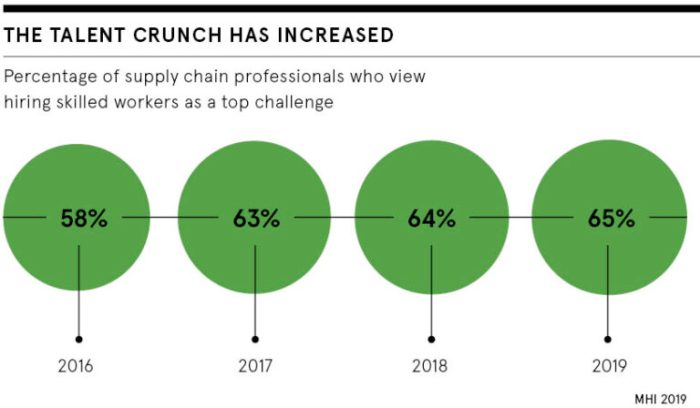
The current supply chain talent shortage is a multifaceted problem stemming from a confluence of factors. These factors interact, creating a complex challenge that requires a multi-pronged approach to solve. Understanding the root causes is crucial for developing effective strategies to attract, train, and retain skilled professionals within the industry.
Impact of Automation and Technological Advancements on Demand for Skilled Workers
The rapid adoption of automation and advanced technologies within supply chains, while increasing efficiency, has also shifted the demand for skilled labor. While some routine tasks are automated, a greater need exists for professionals capable of managing, maintaining, and optimizing these technologies. This necessitates a workforce proficient in data analytics, artificial intelligence, robotics, and sophisticated software systems.
The gap between the existing skillset of the workforce and the requirements of this technologically advanced environment is a significant contributor to the talent shortage. The demand for specialists in areas like supply chain analytics, blockchain technology, and automation integration far outpaces the supply of qualified individuals.
Impact of Aging Workforces and Impending Retirements
A significant portion of the current supply chain workforce is nearing retirement age. This demographic shift creates a looming “skills gap” as experienced professionals leave the industry, taking their institutional knowledge and expertise with them. The lack of a robust pipeline of younger professionals to fill these positions exacerbates the shortage. This is particularly acute in specialized roles requiring years of experience and on-the-job training, such as procurement management, logistics planning, and international trade compliance.
The knowledge transfer from retiring workers is often insufficient, further hindering the industry’s ability to maintain its operational capabilities.
Challenges in Attracting and Retaining Young Professionals to Supply Chain Careers
Attracting young professionals to supply chain careers presents unique challenges. The field is often perceived as less glamorous or exciting compared to other industries, leading to a lack of interest among recent graduates. Furthermore, the complexity of supply chain management and the need for specialized knowledge can be daunting for new entrants. Competitive compensation and benefits packages are also essential for attracting and retaining talent, yet the industry sometimes lags behind other sectors in this regard.
Many young professionals are drawn to industries perceived as offering faster career progression and more immediate impact.
Shortcomings in Current Supply Chain Education and Training Programs
Existing supply chain education and training programs often fail to adequately prepare graduates for the realities of the modern, technology-driven supply chain. Curricula may not be updated quickly enough to reflect the latest advancements in technology and best practices. There is a need for greater collaboration between educational institutions and industry professionals to ensure that programs are relevant and equip graduates with the skills employers demand.
Furthermore, there’s a lack of focus on soft skills such as communication, problem-solving, and teamwork, which are critical for success in supply chain management.
Examples of Companies Successfully Addressing the Talent Shortage Through Innovative Recruitment Strategies
Many companies are proactively addressing the talent shortage through innovative recruitment strategies. Successful examples include:
- Investing in robust apprenticeship and internship programs: Companies like UPS and DHL offer structured programs that provide on-the-job training and mentorship, creating a pipeline of future employees.
- Developing targeted recruitment campaigns to attract diverse talent: Focusing on underrepresented groups and highlighting the diverse career paths within the supply chain can broaden the talent pool.
- Leveraging online platforms and social media to reach potential candidates: Using LinkedIn, Indeed, and other platforms allows companies to connect with passive job seekers and promote the industry.
- Offering competitive compensation and benefits packages: Attracting and retaining top talent requires offering salaries, benefits, and perks that are competitive with other industries.
- Implementing employee development and advancement programs: Investing in employee training and providing clear career paths enhances employee satisfaction and reduces turnover.
Strategies for Addressing the Shortage
The supply chain talent shortage demands a multi-pronged approach encompassing attraction, retention, and development strategies. Addressing this challenge requires a proactive and comprehensive plan involving collaboration between industry, academia, and technology providers. Effective solutions will not only fill immediate gaps but also build a sustainable pipeline of skilled professionals for the future.
Several key strategies can be employed to effectively mitigate the supply chain talent shortage. These strategies focus on enhancing the attractiveness of supply chain careers, developing a skilled workforce through robust training programs, and leveraging technology to improve efficiency and reduce reliance on manual labor. Successful implementation requires a long-term commitment and a collaborative effort from all stakeholders.
Best Practices for Attracting and Retaining Supply Chain Talent
Attracting and retaining top talent in the competitive supply chain sector requires a strategic approach that goes beyond competitive salaries. Organizations must cultivate a positive and engaging work environment, emphasizing professional development opportunities and work-life balance.
Organizations should highlight the dynamic and impactful nature of supply chain careers, showcasing the opportunity to make a real-world difference. Competitive compensation and benefits packages are essential, but equally important are opportunities for professional growth, mentorship programs, and a strong company culture that values employee well-being. Furthermore, promoting diversity and inclusion initiatives can attract a wider pool of qualified candidates.
Comprehensive Training and Development Programs
Investing in comprehensive training and development programs is crucial for upskilling the existing workforce and preparing future generations of supply chain professionals. These programs should incorporate both theoretical knowledge and practical skills development, leveraging diverse learning methods to cater to different learning styles.
A successful program should include elements like structured on-the-job training, mentorship opportunities, online learning platforms, and participation in industry conferences and workshops. It’s vital to integrate emerging technologies and industry best practices into the curriculum to ensure graduates are equipped with the latest skills. Regular performance evaluations and feedback sessions can further enhance the effectiveness of these programs.
For example, a company might partner with a university to offer specialized certifications in areas like logistics management or supply chain analytics.
Successful Employee Upskilling and Reskilling Initiatives
Many companies are successfully upskilling and reskilling their existing employees to address skill gaps within their supply chain operations. This approach not only fills immediate needs but also boosts employee morale and fosters loyalty.
One example is a company that invested in training its warehouse workers in the use of automated guided vehicles (AGVs) and warehouse management systems (WMS). This initiative not only improved efficiency but also provided employees with valuable new skills, making them more marketable and increasing their job satisfaction. Another example involves a logistics company that offered its employees online courses in data analytics and supply chain optimization, equipping them to handle increasingly complex data-driven decision-making.
These initiatives demonstrate the significant return on investment that can be achieved through targeted upskilling and reskilling programs.
Partnerships with Educational Institutions
Collaborating with educational institutions is essential for building a sustainable pipeline of supply chain talent. This can involve joint curriculum development, internships, and collaborative research projects.
Universities and colleges can adapt their supply chain management programs to reflect industry needs, incorporating real-world case studies and emerging technologies into their curriculum. Companies can offer internships and apprenticeships to provide students with practical experience, while also identifying potential future employees. Furthermore, collaborative research projects between industry and academia can lead to the development of innovative solutions to address current supply chain challenges.
This collaborative approach ensures that graduates possess the necessary skills and knowledge to contribute effectively to the industry upon graduation.
Leveraging Technology to Improve Efficiency
The adoption of technology plays a vital role in improving supply chain efficiency and reducing reliance on manual labor. This includes implementing automation technologies, data analytics tools, and advanced planning and scheduling systems.
Investing in technologies such as robotic process automation (RPA), artificial intelligence (AI), and blockchain can automate repetitive tasks, improve forecasting accuracy, and optimize logistics operations. Data analytics tools can provide valuable insights into supply chain performance, enabling proactive identification and mitigation of potential disruptions. These technological advancements not only increase efficiency but also create new opportunities for skilled professionals in areas such as data science and software engineering within the supply chain sector.
For example, the implementation of a Transportation Management System (TMS) can optimize routes, reduce fuel consumption, and improve delivery times, minimizing the need for extensive manual coordination.
The Future of Supply Chain Talent
The supply chain industry is undergoing a period of rapid transformation, driven by technological advancements, globalization, and evolving geopolitical landscapes. This necessitates a fundamental shift in the skills and competencies required for success, demanding a proactive approach to talent development and acquisition. Understanding the future needs of the industry is crucial for both organizations and individuals seeking to thrive in this dynamic environment.
Future Skills and Competencies
The future supply chain professional will need a blend of hard and soft skills. Technical expertise in areas like data analytics, artificial intelligence (AI), and blockchain technology will be paramount. However, equally important will be adaptability, critical thinking, problem-solving, and strong communication skills. For instance, professionals will need to interpret complex data sets generated by AI-powered systems to optimize logistics and make informed decisions.
Furthermore, the ability to collaborate effectively across different departments and geographical locations will be essential in managing increasingly complex global supply chains. A strong understanding of sustainability and ethical sourcing practices will also be highly valued.
The Evolving Role of Technology
Technology is reshaping the supply chain landscape at an unprecedented pace. Automation, AI, and machine learning are automating repetitive tasks, freeing up human resources for more strategic activities. The rise of the Internet of Things (IoT) allows for real-time tracking and monitoring of goods, improving efficiency and visibility. Blockchain technology enhances transparency and security in supply chain transactions.
These technological advancements are creating new roles focused on data analysis, system implementation, and cybersecurity, while also transforming existing roles by requiring professionals to develop proficiency in using and managing these technologies. For example, roles like “Supply Chain Data Scientist” and “Blockchain Supply Chain Specialist” are emerging, while traditional roles like logistics managers require enhanced digital literacy.
Impact of Globalization and Geopolitical Events
Globalization and geopolitical events significantly influence supply chain talent needs. Increased global interconnectedness necessitates professionals with a deep understanding of international trade regulations, geopolitical risks, and cultural nuances. Recent disruptions, such as the COVID-19 pandemic and the war in Ukraine, have highlighted the vulnerability of global supply chains and the need for resilience. Future supply chain professionals will need to be adept at managing risk, developing contingency plans, and navigating complex geopolitical landscapes.
For instance, understanding the impact of trade wars or sanctions on supply chain operations will become a critical skill. Furthermore, professionals need to be equipped to adapt to sudden shifts in global demand and supply.
Creating a More Diverse and Inclusive Workforce
Building a diverse and inclusive supply chain workforce is crucial for fostering innovation, improving decision-making, and attracting top talent. Companies should actively recruit from underrepresented groups, provide equal opportunities for advancement, and create an inclusive work environment where all employees feel valued and respected. Mentorship programs and diversity training can help address unconscious bias and promote inclusivity. This involves actively seeking out candidates from diverse backgrounds, providing inclusive training opportunities, and creating a workplace culture that values different perspectives and experiences.
A diverse workforce can bring a broader range of perspectives and ideas, ultimately leading to more resilient and innovative supply chains.
Projected Growth of Supply Chain Roles
[Visual Description: A bar graph illustrating the projected growth of various supply chain roles over the next decade. The horizontal axis represents different job titles (e.g., Supply Chain Analyst, Logistics Manager, Procurement Specialist, Supply Chain Data Scientist, Sustainability Manager). The vertical axis represents percentage growth. The bars show varying degrees of growth, with Supply Chain Data Scientist and Sustainability Manager showing the highest projected growth, reflecting the increasing importance of data analytics and sustainability in the industry.
Logistics Manager and Procurement Specialist also show significant growth, though less than the data science and sustainability roles. Supply Chain Analyst shows moderate growth, reflecting the continued need for skilled professionals in this core role. The graph uses different colors for each bar to enhance visual appeal and clarity. A title clearly states “Projected Growth of Supply Chain Roles (2024-2034)” and a brief legend explains the color-coding for each job title.]
The supply chain talent shortage presents a significant and multifaceted challenge demanding immediate attention. While technological advancements and evolving global dynamics continue to reshape the industry, proactive strategies focused on talent acquisition, training, and retention are paramount. By fostering collaboration between businesses, educational institutions, and government agencies, we can cultivate a skilled and diverse workforce capable of navigating the complexities of the modern supply chain and ensuring its continued success.
Investing in the future of supply chain talent is not merely a business imperative; it’s essential for global economic stability and resilience.
Questions Often Asked
What are the common entry-level positions in supply chain management?
Common entry-level roles include supply chain analyst, logistics coordinator, procurement specialist, and inventory control specialist.
How can companies improve their employer branding to attract supply chain talent?
Companies can enhance their employer brand by showcasing their company culture, highlighting career development opportunities, and emphasizing the positive impact of their work on the wider community.
What are some innovative recruitment strategies for attracting diverse talent to the supply chain?
Innovative strategies include partnering with diversity-focused organizations, utilizing targeted social media campaigns, and offering flexible work arrangements to appeal to a broader range of candidates.
What salary expectations should companies have for experienced supply chain professionals?
Salary expectations vary significantly based on experience, location, and specific role, but competitive compensation packages are crucial for attracting and retaining top talent.


